ISO 9001:2026 is here.Published on 16 September 2026, the sixth edition of the international standard for quality management systems replaces ISO 9001:2015. It builds on the existing framework, with greater emphasis on leadership, quality culture and ethical behaviour, and clearer treatment of risks and opportunities.
The QMS model is being refined, not replaced.
This information hub explains the main changes, outlines the certification transition requirements and provides practical guidance on preparing your organization. Whether you are already certified or considering certification for the first time, use the sections below to understand what the revised standard means for you and identify your next steps.
See the launch of ISO 9001:2026 here
Global ACI has established a three-year transition period. Organizations with accredited ISO 9001:2015 certification must complete their transition to ISO 9001:2026, including issuance of the updated certificate, by 30 September 2029. Plan early and contact the TTBS Certification Division to discuss your transition and audit arrangements.
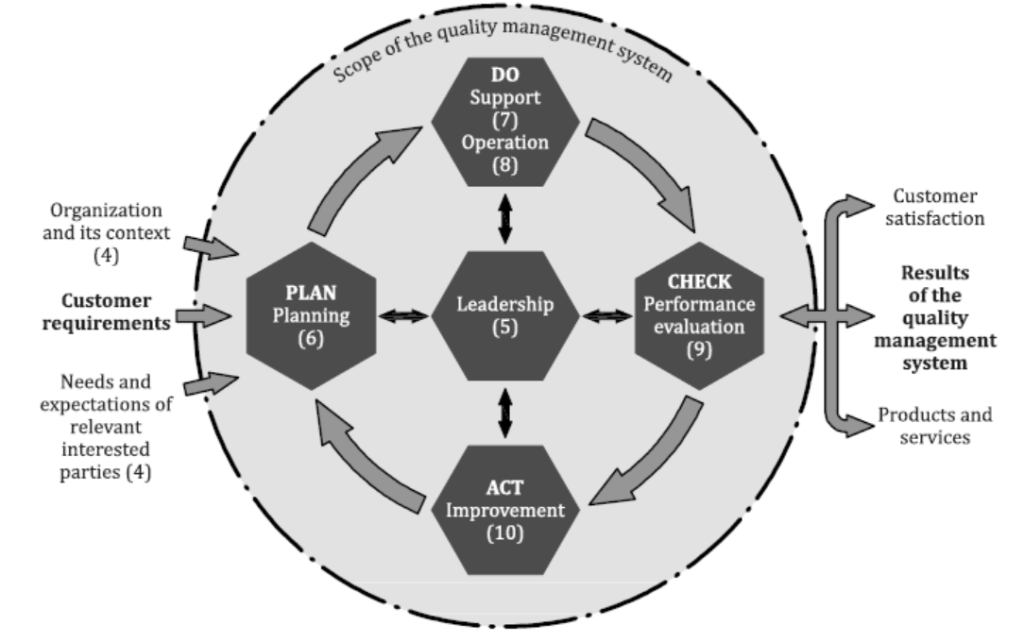
The diagram below shows how the main sections of ISO 9001 fit within the Plan–Do–Check–Act (PDCA) cycle. It helps you see how the requirements connect as a management system, rather than treating each clause as a separate task.
Diagram of the structure of ISO 9001:2026 is mapped against the PDCA cycle [Ref: ISO 9001:2026]
. .
Key changes in ISO 9001:2026
Understanding what has changed is the starting point for planning your transition. ISO 9001:2026 introduces targeted updates to requirements, alongside further clarification to help organizations interpret and apply them consistently. The practical task is to identify where your existing quality management system already meets the revised requirements and where changes are needed.
The summary below highlights key changes compared with ISO 9001:2015, grouped by subject area. Use it to guide your initial review and gap analysis: identify the processes and people affected, consider how your current arrangements address the revised requirements, and determine what action is needed. Look beyond documentation to how responsibilities, decisions and everyday activities are managed.
Summary of Changes
1 Context of the Organization
Needs and Expectations of Interested Parties now includes a specific requirement to determine which requirements will be addressed through the QMS.
Climate change requirements from ISO 9001:2015/Amd 1:2024 are now incorporated into the body of the main standard.
2 Leadership
Quality culture, ethical behaviour and opportunity-based thinking to be promoted by Leadership.
Support expanded from management to all relevant roles.
3 Planning
QMS changes expanded to consider the availability of information, communication, monitoring and evaluation, and how results will be reviewed.
Risks and opportunities have been separated and must now be considered independently. In addition to being determined, they must also be analyzed and evaluated.
4 Support
Organizational knowledge expanded to require that it be retained, applied and shared to achieve QMS results.
Awareness expanded to include organizational quality culture and ethical behaviour.
5 Operation
Customer communication expanded to include information on contingency actions and disruptions to production or service provision.
Communication of changes to product and service requirements expanded to include relevant interested parties, in addition to customers.
Design and Development
Planning to include other relevant interested parties, in addition to customers and users;
Outputs expanded to include essential product and service information, in addition to product or service characteristics.
Externally provided products and services expanded to cover controls where products and services are provided directly to the customer.
Control of Production and Service Provision expanded to include the use, in addition to the availability of documented information, for product and service characteristics, activities and results to be achieved.
6 Performance Evaluation
Internal audit objectives must now be defined for each audit.
Management review must now include changes in relevant interested-party needs and expectations.
7 Annexes
Annex A – Clarification of structure, terminology and clauses expanded to provide clause-by-clause clarification of terminology and intent. Please note that, as an informative annex, these are not requirements, but are invaluable in understanding the requirements.
Annex B – Other International Standards on quality management and quality management systems developed by ISO/TC 176 has been removed.
.
Building a strong quality culture
Quality culture is how an organization’s commitment to quality is reflected in everyday decisions and behaviours. It becomes especially visible when deadlines are tight, problems arise or priorities compete. A strong quality culture encourages people to take responsibility for their work, raise concerns early and learn from mistakes, rather than treating quality as the quality department’s responsibility alone.
ISO 9001:2026 reinforces the importance of quality culture through its leadership and awareness requirements. The table below connects that emphasis to everyday practice: what a strong quality culture looks like, how leaders can support it and what evidence auditors may examine. These are examples to support understanding and self assessment, not ISO 9001:2026 requirements. Use these examples to review whether your organization’s stated commitments are reflected in how people actually work, and to identify areas for improvement.
What a strong culture looks like
What leaders can do
Examples of Evidence
People understand how their work affects customers and QMS results.
Quality objectives influence operational decisions and priorities.
Teams learn from complaints.
Problems are reported early rather than hidden or passed downstream.
Improvement belongs to everyone, not only the quality department.
Set consistent examples when cost, speed and quality compete.
Provide resources, competence and time for effective controls.
Respond constructively when people raise concerns.
Align targets, outcomes and incentives.
Use management review to address behaviour as well as metrics.
Leadership decisions related to quality.
Employee interviews and awareness of objectives and escalation routes.
Complaint, nonconformity and corrective-action handling.
Training, recognition, rewards and performance management practices.
Patterns in internal audits, repeat issues and improvement activity.
.
Ethical Behaviour
This connects the role of leadership in promoting ethical behaviour and people understanding its importance in their work. In practice, the focus is on how ethical expectations are demonstrated and supported in everyday activities.
Within a quality management system, examples include maintaining accurate records, reporting nonconformities honestly and avoiding pressure to conceal problems or release work prematurely. The table below illustrates areas to consider when reviewing your organization’s practices, including how concerns are raised and how targets, incentives and business relationships may influence behaviour. These are examples to support understanding and self assessment, not ISO 9001:2026 requirements. Use these examples to identify where existing arrangements support ethical behaviour and where improvements may be needed.
Truthful information
Safe escalation
Responsible incentives and relationships
Quality data and records should be complete, accurate and not manipulated.
Nonconformities, complaints and test results should be reported honestly.
Customer, regulatory and contractual requirements should be honoured.
People should know where and how to raise a concern.
Managers should protect staff from retaliation for good-faith reporting.
Serious issues should be escalated promptly and investigated fairly.
Targets should not encourage concealment, shortcuts or premature release.
Supplier and partner expectations should include integrity and traceability.
Conflicts of interest and improper influence should be identified and controlled.
Practical actions for organizations
✓
Protect data integrity. Use access controls, approvals, change history and retention arrangements to ensure that the integrity of data is preserved.
✓
Make it safe to raise concerns. Ensure staff have a process and know how to raise concerns.
✓
Test ethical expectations through audits and reviews. Use internal audits, management review and supplier evaluations to confirm that ethical expectations are applied in practice.
✓
Review performance targets. Look for incentives that could promote under-reporting, data manipulation or rushed release.
✓
Use realistic scenarios in training. Discuss dilemmas involving defects, customer pressure, supplier failures and schedule commitments.
✓
Align the QMS and Code of Conduct / Ethics. Make accurate monitoring, measurement and reporting a part of the Code of Conduct / Ethics.
.
How to prepare for the new standard
Preparing for ISO 9001:2026 starts with understanding what needs to change in your organization. Review the revised requirements against your existing quality management system, taking account of changes in your organization’s context. Use a gap analysis to identify where current arrangements already meet the requirements and where action is needed, rather than assuming that every process or document must be rewritten. Global ACI’s recognises that the impact of the changes will differ between organizations.
The checklist below suggests practical actions for planning, implementing and reviewing your changes. Use it to assign responsibilities, identify resource and training needs, and establish realistic timescales. Include internal audits and management review in your preparations, and discuss transition audit arrangements with TTBS early enough to allow time for any necessary follow-up.
Review and plan
Implement and verify
Avoid three common mistakes
☑Appoint a transition owner
☑Obtain the published standard Contact the TTBS Standard Information Centre.
☑Brief top management on the revised requirements and transition arrangements
☑Complete a gap analysis
☑Assess culture and ethics
☑Separate risks and opportunities
☑Review management of change
☑Build a transition plan
☑Monitor TTBS updates on the transition
☑Update processes and documented information
☑Perform training on the new standard
☑Conduct an internal audit of the revised arrangements
☑Conduct management review
☑Schedule the transition audit with TTBS
☒Do not rewrite everything Start with evidence and gaps; preserve processes that already work.
☒Do not reduce ethics and culture to a written policy Test behaviour, incentives, reporting and leadership response.
☒Do not wait until the deadline Plan sufficient time for implementation, the transition audit and any necessary corrective action, followed by the certification decision and certificate issuance. The certification body must complete the transition of certified clients, including certificate issuance, before 30 September 2029.
Use this checklist as practical preparation guidance. Read it alongside ISO 9001:2026, Global ACI’s transition requirements and the transition arrangements communicated by TTBS.
.
How the transition works
Transition to ISO 9001:2026 requires the combined efforts of accreditation bodies, certification bodies and certified organizations.Global ACI’s published transition requirements establish responsibilities and timescales for moving certification from ISO 9001:2015 to the revised edition, within a three-year transition period.
Use the pathway below alongside the preparation checklist to plan your organization’s transition with TTBS.
1 Publication of ISO 9001:2026
ISO 9001:2026 was published on 16 September 2026, replacing ISO 9001:2015 and its 2024 amendment.
2 Transition requirements set by Global ACI
Published requirements establish a three-year transition period, with responsibilities and deadlines for accreditation bodies and accredited certification bodies.
3 Certification-body readiness
The certification body prepares its personnel and processes. Accredited ISO 9001:2026 certification is permitted only after its accreditation body has transitioned its accreditation.
4 Organization preparation
Complete a gap analysis, implement necessary changes, provide training, and conduct internal audits and management review.
5 Transition audit
The certification body must conduct a transition audit. This may accompany a surveillance or recertification audit, or be conducted as a separate special audit.
6 Certification decision and updated certificate
After its accreditation transition, the certification body must make the transition certification decision using the audit results and other applicable information. An updated certificate follows a positive decision.
.
What is confirmed and what to confirm with TTBS
The international transition requirements are now confirmed. Global ACI has established the transition period and the responsibilities of accreditation and certification bodies. The table below distinguishes those confirmed requirements from the arrangements to discuss with TTBS when planning your organization’s certification.
Use this information alongside your preparation plan to agree appropriate audit timing and understand what applies to your current certificate or new certification application.
Confirmed requirements
Arrangements to confirm with TTBS
Publication of the revised standard.
ISO 9001:2026 was published on 16 September 2026, replacing ISO 9001:2015 and its 2024 amendment.
Availability of ISO 9001:2026 transition audits.
Confirm when TTBS can provide ISO 9001:2026 certification.
Three-year transition period.
Certification bodies must complete their certified clients’ transitions, including certificate issuance, before 30 September 2029.
Your transition audit arrangements.
Agree on the audit timing and whether transition will accompany surveillance or recertification, or require a separate special audit.
Cut-off for new certifications.
Following 31 March 2028, new and initial accredited certifications must be to ISO 9001:2026; new ISO 9001:2015 certifications cannot be issued after that date.
New certification applications.
Confirm which edition TTBS can offer and the application and audit schedule needed to meet the applicable cut-off.
Validity limit for the previous edition.
Accredited ISO 9001:2015 certifications are no longer valid at the transition end date, 30 September 2029.
Your current certification cycle.
Confirm how your certificate’s expiry date and forthcoming surveillance or recertification audits fit into the transition plan.
.
What happens to ISO 9001:2015 certificates?
Global ACI’s transition requirements set a validity limit for ISO 9001:2015 certification: 30 September 2029. Certification bodies must complete their certified clients’ transitions to ISO 9001:2026, including certificate issuance, before that date.
Check your certificate’s expiry date and forthcoming audits with TTBS when planning your transition. Do not assume that the transition period automatically extends your existing certificate. The table below outlines what to discuss according to your certification status and audit schedule.
Your situation
What to do
Existing ISO 9001:2015 certificate
Continue to maintain conformity and complete surveillance activities. Agree a transition timetable with TTBS that allows the certification body to complete your transition, including certificate issuance, before 30 September 2029.
Surveillance audit due
Ask TTBS whether your transition audit can accompany your next surveillance audit. Transition may also be undertaken with recertification or through a separate special audit.
Recertification due soon
Confirm which edition TTBS will audit against and whether recertification can include transition. Recertification to ISO 9001:2015 does not remove the need to transition or extend validity beyond the transition end date.
New certification applicant
Confirm the edition and audit timetable with TTBS. Following 31 March 2028, new/initial accredited certifications must be to ISO 9001:2026; no new ISO 9001:2015 certifications can be issued after that date.
Check the transition limit even when a later expiry date is printed on your certificate. Global ACI does not require existing certificates to be amended solely to show a shortened expiry date, although certification bodies may do so to reduce confusion.