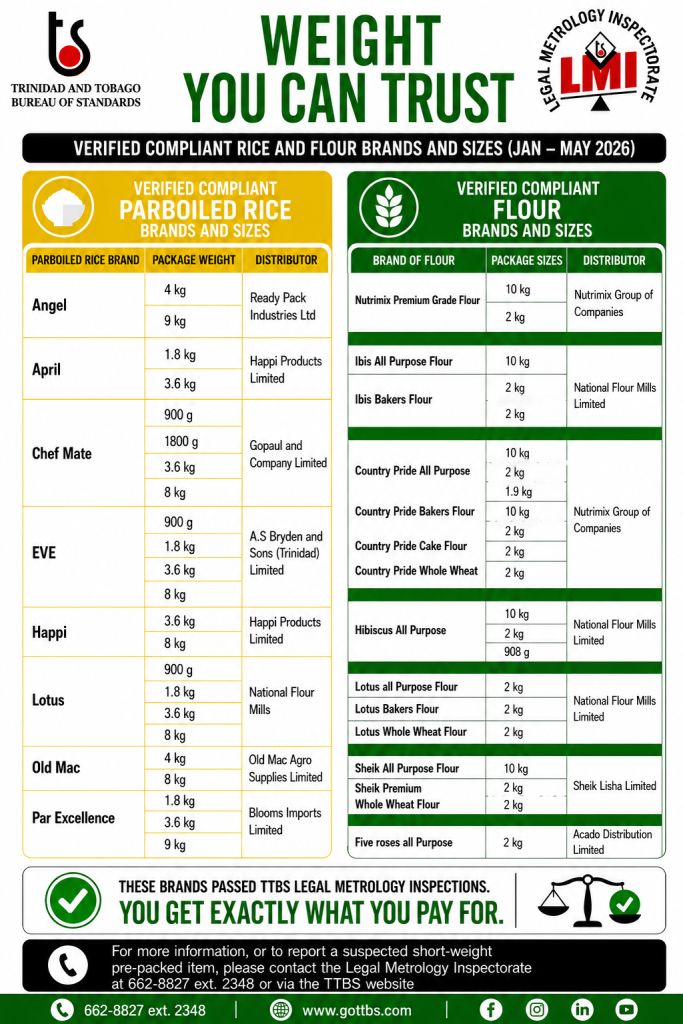
When you purchase a bag of rice or a sack of flour, do you sometimes worry that the quantity stated on the package is not what you are paying for? As grocery prices continue to affect household budgets, how can one be confident that the weight printed on the package accurately reflects the amount of product inside?
The Trinidad and Tobago Bureau of Standards (TTBS) through its Legal Metrology Inspectorate (LMI), helps ensure accuracy by regularly inspecting pre-packed goods sold in supermarkets across Trinidad and Tobago. By ensuring that pre-packed goods comply with the Metrology Quantities of Goods Regulations, 2015, the LMI protects consumers, promotes fair trade, and helps guarantee that citizens receive what they pay for.
Net Content in Pre-packaged Goods
Through routine inspections and testing, the LMI serves as a silent guardian for consumers by ensuring that pre-packed goods sold in supermarkets and shops contain the quantity stated on their labels. But before looking at how the inspections work, it is important to understand the legal definition of what is being measured.
According to the Metrology Quantities of Goods Regulations, 2015, Net Content is the quantity of product contained in a package, excluding the wrapper, packaging material, labels, ties, or any other material packed with the product. In simple terms, when the LMI tests a bag of flour, the weight of the plastic or paper bag itself (the tare weight) is subtracted. This ensures that consumer would be receiving the stated quantity of flour or rice inside, excluding the packaging weight.
Rice and flour are classified as “pre-packed goods”—meaning they are placed in a package before being offered for sale, and the quantity cannot be altered without opening the package.
How do Inspections Work?
The inspection process is as follows:
- Statistical Sampling: Inspectors do not just weigh a single bag. They select a statistically valid sample size from a specific batch or “lot” of goods.
- High-Precision Testing: Using verified weighing devices inspectors determine the gross weight, calculate the packaging (tare) weight, and find the net content.
- The Three Rules of Compliance: For a batch of rice or flour to pass inspection, it must meet three strict criteria under the 2015 Regulations:
- The average net content of the sample batch cannot be less than the nominal quantity declared on the label.
- Only a small, legally permissible number of individual packages can fall slightly below the declared weight (known as the Tolerable deficiency)
- Zero Tolerance for Deception: No single package can be short-weighted by more than twice the allowed Tolerable deficiency.
If a batch fails, the LMI has the authority to order the distributor to remove the short-weight items from the shelves, correct the weights, or face legal penalties.
Why This Matters
The enforcement of these regulations protects citizens:
- Value for Money: LMI inspections prevent “shrinkflation” (subtly reducing product weight while keeping prices the same), ensuring families get every single gram they pay for.
- Market Fairness: By holding all brands to the exact same legal standard, the LMI creates a level playing field. Honest local packers and importers are protected from unfair competition by entities that might attempt to short-weight products to undercut prices.
- Protecting Household Budgets: Ensuring accurate measurements directly safeguards the purchasing power of the citizens.
The LMI regularly verifies local and imported pre-packed staples. This will allow consumers to shop with confidence.